Best Dutch Ovens for Beginners 2026: Top 5 Picks
The 5 best Dutch ovens for beginners in 2026
A Dutch oven is one of the most versatile pots you can own — it braises, roasts, bakes, simmers and fries, all in one heavy, durable pot. From no-knead sourdough to beef stew, chili and whole roast chicken, it handles it all. We compared 11 enameled and bare cast iron Dutch ovens and recommend five, each the best choice for a different kind of beginner cook.
The quick verdict
Lodge Enameled Cast Iron 6-Quart
Roughly 90% of premium performance at a quarter of the price, with zero seasoning or special care.
Cuisinart Chef’s Classic 5-Quart
Real enameled cast iron from a trusted brand at the most approachable price here.
Le Creuset Signature Round
The gold standard — an heirloom piece with the best enamel, lighter weight and a lifetime warranty.
Compare all 5 at a glance
| Model | Capacity | Material | Best for | Price | |
|---|---|---|---|---|---|
| Lodge Enameled 6-QtWinner | 6 qt | Enameled cast iron | Overall | $$ | Check price |
| Le Creuset Signature | 5.5 qt | Enameled cast iron | Premium | $$$ | Check price |
| Cuisinart Chef’s Classic | 5 qt | Enameled cast iron | Budget | $ | Check price |
| Staub Round Cocotte | 5.5 qt | Enameled cast iron | Serious cooking | $$$ | Check price |
| Lodge Bare Cast Iron 5-Qt | 5 qt | Seasoned cast iron | Traditional | $ | Check price |
The 5 best Dutch ovens for beginners
1. Lodge Enameled Cast Iron 6-Quart Dutch Oven
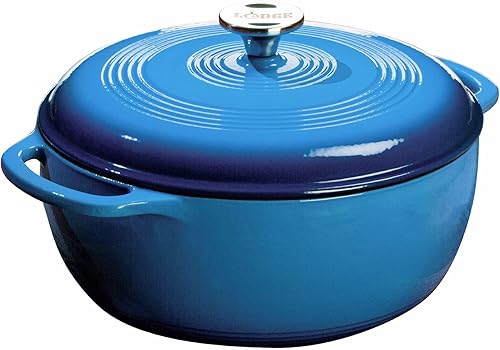
Why we picked it: Lodge combines its cast iron expertise with an easy-care enamel coating, giving you about 90% of premium performance at a quarter of the price. There’s no seasoning to learn — just cook, wash and enjoy — and the 6-quart size is the sweet spot for soups, stews, braised meats and even baking bread. Even heat distribution and retention round out a clear step above bare-bones starter pots.
Pros
- Excellent quality at a fraction of Le Creuset’s price
- No seasoning required — ready to use immediately
- Even heat distribution and retention
- Works on all cooktops, including induction
Cons
- Enamel can chip if dropped
- Heavy at 13 pounds
2. Le Creuset Signature Round Dutch Oven
Why we picked it: this is the gold standard, and a piece many cooks consider a lifetime investment. Le Creuset has made enameled cast iron in France since 1925, and these are heirloom pots passed down through generations. The lighter weight, superior enamel quality, sand-colored interior that makes monitoring browning easy, and a tight lid that locks in moisture justify the premium for anyone who can afford it.
Pros
- Legendary quality and durability
- Lighter than many competitors
- Sand interior makes browning easy to monitor
- Tight lid retains moisture perfectly
Cons
- Very expensive
- 5.5-quart is slightly smaller than competitors
Skip the research — get the Kitchen Build Kit
3 budget-tiered shopping lists ($300 / $750 / $1,500) with every cooker, pan and tool we recommend. Instant PDF.
3. Cuisinart Chef’s Classic 5-Quart Dutch Oven
Why we picked it: the Cuisinart Chef’s Classic delivers a surprisingly good enameled cast iron experience at a very approachable price. It’s solid, even-heating, and backed by a trusted brand — the logical low-risk pick for a budget-conscious beginner who still wants real enameled cast iron rather than a thin starter pot. Wide handles make it easy to grip in and out of the oven.
Pros
- Very affordable for enameled cast iron
- Solid build quality from a trusted brand
- Wide handles for easy gripping
- Even heating performance
Cons
- Enamel isn’t as refined as Le Creuset or Staub
- Fewer color options
4. Staub Round Cocotte 5.5-Quart
Why we picked it: the Staub Cocotte is built for cooks who care about technique. Its black matte enamel interior excels at browning and searing, and self-basting spikes on the underside of the lid create a continuous moisture cycle for exceptionally moist braises. Premium Alsatian craftsmanship and a dark interior that hides stains make it the pick when you want to push your cooking further.
Pros
- Black interior excels at browning and searing
- Self-basting lid creates a continuous moisture cycle
- Premium Alsatian craftsmanship
- Dark interior hides stains
Cons
- Premium pricing, similar to Le Creuset
- Heavier than Le Creuset
5. Lodge Bare Cast Iron 5-Quart Dutch Oven
Why we picked it: this is the classic bare cast iron option for cooks who want to develop their own seasoning and enjoy the traditional experience. It’s the most affordable Dutch oven here, handles higher temperatures than enameled, and is virtually indestructible — great for the stovetop, the oven and the campfire alike. Seasoning and flavor only get better with use.
Pros
- Most affordable Dutch oven option
- Develops better seasoning and flavor over time
- Handles higher temperatures than enameled
- Virtually indestructible, great for outdoor cooking
Cons
- Requires seasoning maintenance
- Can rust if not properly cared for
Dutch oven buying guide for beginners
Enameled vs. bare cast iron. Enameled is what we recommend for most beginners — no seasoning needed, easy to clean, non-reactive to acidic foods, and available in beautiful colors, with a coating that prevents rust. Bare cast iron is more affordable, better for high-heat searing, and develops a natural non-stick patina over time, but it asks for more maintenance.
What size should you get. For most beginners a 5.5- to 6-quart round Dutch oven is the most versatile size. It handles recipes for four to six people comfortably and fits most standard ovens. If you frequently cook for large groups, step up to a 7-quart.
Round vs. oval. Round is best for soups, stews, chili, rice and bread baking, and it sits on standard burners better. Oval suits roasting whole chickens, pork loins and oblong cuts, but it doesn’t center well on round burners. For beginners, round is the more versatile choice.
How we evaluate
We score every product on five criteria — performance, build quality, ease of use, versatility, and value — weighted toward real-world home use. Our picks combine hands-on use of the gear we own, structured spec comparison across the category, and analysis of thousands of verified owner reviews. We re-check this guide as new models ship and prices move.
The bottom line
For most beginners the Lodge 6-Quart Enameled Dutch Oven is the best starting point — excellent quality at a fair price with zero maintenance hassle. If you want a lifetime piece, the Le Creuset Signature is unmatched, and budget-conscious beginners get solid performance from the Cuisinart Chef’s Classic. Whichever you choose, our Kitchen Build Kit shows exactly what to pair it with.
Frequently asked questions
What size Dutch oven is best for a beginner?
A 5.5 to 6-quart round Dutch oven is the sweet spot for most households and the size we recommend first — it’s big enough for a batch of chili, a stew for four to six, or a round of no-knead bread, yet still manageable to lift. Our top pick, the Lodge Enameled 6-Quart, lands right in this range. Smaller 3 to 4-quart models suit couples or side dishes but feel cramped for bread baking, while 7-quart-plus pots get heavy and harder to store. If you can own only one, a 6-quart round handles the widest variety of recipes.
Is an expensive Dutch oven like Le Creuset worth it over a budget one?
For a beginner, usually not as a first pot. Affordable enameled cast iron like the Lodge 6-Quart or Cuisinart Chef’s Classic delivers roughly 90% of the cooking performance — the same even heat retention and braising ability — at a quarter of the price. What you pay extra for with Le Creuset or Staub is refinement: smoother, more durable enamel, lighter weight, a better-fitting lid, and a lifetime warranty. If you cook constantly or want a pot to pass down, the premium is justified. If you’re just testing whether you’ll use it, start with Lodge and upgrade later if you fall in love with it.
What’s the difference between a black and a light-colored enamel interior?
It affects both cooking and upkeep. A light or sand-colored interior, like Le Creuset‘s, makes it easy to see how dark your fond and braising liquid are getting, which helps you avoid burning — but it shows stains over time (cosmetic only). A black matte interior, like Staub‘s, is built for browning and searing at higher heat and hides stains well, though it’s harder to judge color in the pot. For learning to cook, a light interior is more forgiving because you can monitor browning; experienced cooks who sear aggressively often prefer the dark matte finish.
How do you prevent enamel from staining or chipping?
Enamel is durable but not indestructible. To avoid chips, never bang metal utensils against the rim, don’t drop or knock the pot, and let it cool before washing — thermal shock can crack the coating. Use wooden or silicone tools rather than metal. For staining, which is cosmetic and common on light interiors like the Lodge’s or Le Creuset’s, avoid empty pots over high heat and clean promptly. To remove built-up stains, simmer water with a few tablespoons of baking soda, or make a baking-soda paste and let it sit before gently scrubbing — skip harsh abrasives and steel wool, which dull the finish.
Should a beginner choose enameled or bare cast iron for a Dutch oven?
Enameled is the easier starting point, which is why four of our five picks are enameled. With a coated pot like the Lodge Enameled 6-Quart there’s no seasoning to learn, you can cook acidic dishes like tomato sauce and wine braises without issue, and cleanup is straightforward. Bare seasoned cast iron, like the Lodge Bare 5-Quart, costs less and develops a natural nonstick patina, but it requires re-seasoning, careful drying to prevent rust, and isn’t ideal for long-simmered acidic foods that can strip the seasoning and pick up a metallic taste. Begin with enamel unless you specifically want the traditional bare-iron experience.