Best Stand Mixers 2026: Budget to Pro (Top 5)
The 5 best stand mixers for 2026
A quality stand mixer transforms your baking from good to extraordinary — whether you’re kneading bread dough, whipping meringue, or mixing cookie batter. We compared more than 20 current models across every budget, from the iconic KitchenAid Artisan to wallet-friendly alternatives that still deliver professional results, and recommend five — each the best choice for a different kind of baker.
The quick verdict
KitchenAid Artisan Series 5-Qt
Legendary build, 59-point mixing and an unmatched attachment ecosystem — the one mixer that does it all.
Cuisinart SM-50 5.5-Qt
A 500-watt motor that out-muscles the Artisan, at a noticeably lower price — the smart-money pick.
KitchenAid Professional 600
575 watts and a bowl-lift design that powers through stiff bread dough and double batches without complaint.
Compare all 5 at a glance
| Model | Capacity | Motor | Best for | Price | |
|---|---|---|---|---|---|
| KitchenAid Artisan 5-QtWinner | 5 qt | 325 W | Overall | $$$ | Check price |
| Cuisinart SM-50 | 5.5 qt | 500 W | Value | $$ | Check price |
| KitchenAid Professional 600 | 6 qt | 575 W | Heavy dough | $$$ | Check price |
| Hamilton Beach Eclectrics | 4.5 qt | 400 W | Budget | $ | Check price |
| Breville Scraper Mixer Pro | 5 qt | 550 W | Premium | $$$ | Check price |
The 5 best stand mixers
1. KitchenAid Artisan Series 5-Qt Stand Mixer
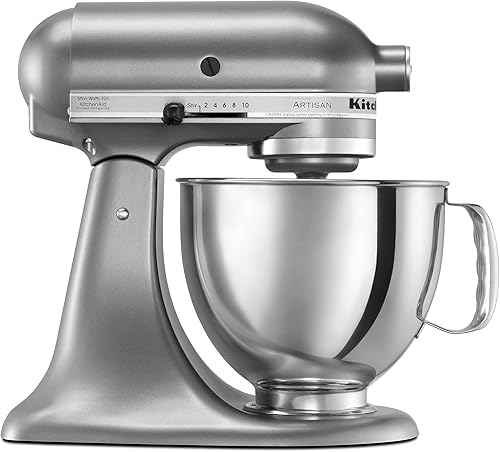
Why we picked it: the Artisan remains the gold standard for home bakers. Its 59-point planetary mixing action reaches every part of the bowl, the all-metal construction routinely lasts 20+ years, and the attachment ecosystem — pasta roller, meat grinder, ice cream maker and more — is unmatched. If you bake regularly and want one mixer to do it all, this is the one.
Pros
- 59-point planetary action reaches the whole bowl
- 10+ optional hub-powered attachments
- Available in 40+ colors
- Tilt-head makes bowl access easy
- Durable all-metal build, 5-year warranty
Cons
- Can struggle with very stiff bread doughs
- 325 W is adequate but not the most powerful
- Premium price point
2. Cuisinart SM-50 5.5-Qt Stand Mixer
Why we picked it: the SM-50 delivers impressive performance at a significantly lower price than KitchenAid. Its 500-watt motor is actually more powerful than the Artisan’s, the die-cast metal construction feels premium, and 12 speed settings give precise control. It’s the smart choice if you want near-KitchenAid quality without the KitchenAid price tag, especially if you prioritize motor power over the attachment ecosystem.
Pros
- 500 W — more powerful than the Artisan
- 12 speed settings for precise control
- Die-cast metal construction feels premium
- Tilt-back head with auto-off safety
Cons
- Fewer attachment options than KitchenAid
- Minor vibration at high speeds
- Less color variety
Skip the research — get the Kitchen Build Kit
3 budget-tiered shopping lists ($300 / $750 / $1,500) with every cooker, pan and tool we recommend. Instant PDF.
3. KitchenAid Professional 600 Series
Why we picked it: the Pro 600 is the serious baker’s choice. A powerful 575-watt motor and bowl-lift design handle heavy bread dough, double batches and extended mixing sessions without breaking a sweat, and the 6-quart bowl takes up to 13 dozen cookies. If you regularly make bread, pizza dough or large batches, the extra power and capacity make a real difference with heavy, elastic doughs.
Pros
- 575 W handles even the stiffest dough
- Bowl-lift design is stable under heavy loads
- 6-qt capacity for large batches
- Efficient spiral dough hook
- Commercial-grade durability
Cons
- Heavier and needs more counter space
- Bowl-lift is less convenient for quick tasks
- Higher price
4. Hamilton Beach Eclectrics All-Metal Stand Mixer
Why we picked it: the Eclectrics proves you don’t need to spend a fortune to get a capable stand mixer. With a 400-watt motor, planetary mixing action and a 4.5-quart bowl, it handles everyday baking with ease — and the all-metal die-cast body is a rarity at this price. If you’re new to baking or working within a budget, it does everything a casual baker needs without the premium price tag.
Pros
- All-metal die-cast body at an affordable price
- 400 W handles most baking tasks
- Tilt-up head with auto shutoff
- Planetary mixing action
- Locking suction-cup base for stability
Cons
- 4.5-qt bowl is smaller than competitors
- Motor can struggle with very stiff dough
- Limited attachment ecosystem
5. Breville Scraper Mixer Pro
Why we picked it: the Breville BEM800XL is an engineering marvel. Its patented scraper beater actively pushes ingredients off the sides and bottom of the bowl, eliminating the need to stop and scrape by hand — something every baker appreciates. Add a 550-watt motor, electronic speed sensing that adjusts torque automatically, and a count-up timer, and it’s for bakers who want the best mixing experience possible.
Pros
- Patented scraper beater ends manual scraping
- 550 W provides excellent power
- Count-up timer tracks mixing duration
- Electronic speed sensing adjusts torque
- Premium build with steel gears
Cons
- Premium price
- Limited third-party attachment options
- Heavier than similar-capacity mixers
Stand mixer buying guide
Motor power. Wattage determines what your mixer can handle. For light baking like cookies and cakes, 300–400 watts is sufficient; for bread dough and heavy batters, look for 500 watts or more. More power also means the mixer runs cooler and lasts longer under load.
Bowl capacity. A 5-quart bowl handles most home baking — up to about 9 dozen cookies per batch. If you regularly bake for crowds or make large bread batches, consider a 6–7 quart model; smaller 4–4.5 quart bowls work fine for individuals or couples.
Tilt-head vs. bowl-lift. Tilt-head mixers are more convenient for everyday use — just tilt the head back to reach the bowl. Bowl-lift mixers are sturdier under heavy loads and usually come with larger bowls. Choose based on what you bake most often.
Build quality. All-metal construction (zinc or aluminum die-cast) lasts decades, while plastic-bodied mixers are lighter and cheaper but may not withstand heavy use. Check for metal gears inside — they outlast nylon gears significantly.
Attachments. KitchenAid leads here with 10+ optional hub-powered attachments like a pasta roller, meat grinder and ice cream maker. If you want a multi-use appliance the ecosystem matters; otherwise the included beater, hook and whisk are all most bakers need.
How we evaluate
We score every product on five criteria — performance, build quality, ease of use, versatility, and value — weighted toward real-world home use. Our picks combine hands-on use of the gear we own, structured spec comparison across the category, and analysis of thousands of verified owner reviews. We re-check this guide as new models ship and prices move.
The bottom line
For most home bakers the KitchenAid Artisan is the best overall stand mixer — versatile, durable, and backed by the best attachment ecosystem. If you need more power for bread, upgrade to the Professional 600 Series; for the best value, the Cuisinart SM-50 delivers exceptional performance at a lower price. Whichever you choose, our Kitchen Build Kit shows exactly what to pair it with.
Frequently asked questions
How many watts does a stand mixer need for kneading bread dough?
Wattage matters most for heavy, elastic doughs. The iconic KitchenAid Artisan runs 325 watts, which is plenty for cookies, cakes, and meringue but can bog down on very stiff bread dough. If you bake bread weekly, step up to 500-plus watts: the Cuisinart SM-50 (500W) actually out-muscles the Artisan, and the KitchenAid Professional 600 (575W) with its bowl-lift design powers through double batches of bread dough without complaint. That said, watts aren’t everything; motor design, gearing, and build quality matter too. For occasional baking, 325 to 400 watts is fine. For serious or frequent bread, prioritize a higher-wattage bowl-lift model.
Should I get a tilt-head or a bowl-lift stand mixer?
It’s a trade-off between convenience and muscle. Tilt-head mixers, like the KitchenAid Artisan and Cuisinart SM-50, let you flip the head back for easy bowl and beater access, making them handier for quick, frequent jobs like whipping cream or a single batch of cookies. Bowl-lift mixers, like the KitchenAid Professional 600, raise the bowl on a stable arm and are built to stay rock-solid under heavy loads, which is ideal for stiff bread dough and large batches. Choose tilt-head if you bake light-to-moderate and value ease. Choose bowl-lift if you regularly make bread, pizza dough, or double batches where stability and power win out.
What bowl capacity do I need in a stand mixer?
Match capacity to your batch sizes. A 4.5-quart bowl (Hamilton Beach Eclectrics) handles everyday baking for casual bakers but fills up fast with larger recipes. Five to 5.5 quarts, like the KitchenAid Artisan (5 qt) and Cuisinart SM-50 (5.5 qt), is the all-purpose sweet spot for most home bakers and fits standard cookie and cake recipes comfortably. Six quarts (KitchenAid Professional 600) takes up to 13 dozen cookies and suits large families, frequent entertainers, and double batches. Bigger bowls also need a minimum amount of ingredients to mix well, so a huge bowl can actually struggle with very small quantities like a single egg white.
Is a KitchenAid worth the price, or is a cheaper stand mixer just as good?
For many bakers, the Cuisinart SM-50 is the smart-money pick: a more powerful 500-watt motor and premium die-cast build for noticeably less than the Artisan. So no, KitchenAid isn’t always the best value. What you pay extra for with KitchenAid is the legendary all-metal durability (Artisans routinely last 20-plus years), 40-plus colors, and an unmatched attachment ecosystem (pasta roller, meat grinder, ice cream maker). If you want one mixer for decades and dream of expanding with attachments, KitchenAid earns its price. If you prioritize raw motor power and value over the ecosystem, the Cuisinart delivers near-KitchenAid quality for less.
Do stand mixer attachments transfer between brands and models?
Generally no, attachments are brand-specific, which is a key buying consideration. KitchenAid’s biggest advantage is its universal power hub: the front attachment point fits the same pasta rollers, grinders, and accessories across nearly all KitchenAid models, so attachments bought today work on a future KitchenAid. Other brands like Cuisinart, Hamilton Beach, and Breville have far thinner or proprietary accessory lineups, so you’re mostly limited to the included beater, whisk, and dough hook. If you envision expanding into pasta-making or grinding meat down the road, that ecosystem lock-in is a strong reason to choose KitchenAid even at a higher upfront cost.